
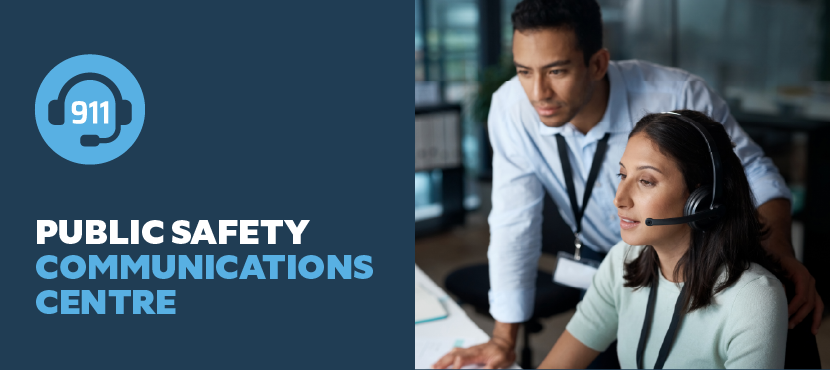
The Public Safety Communications Centre (PSCC) is a fully integrated emergency communications centre serving the City of Grande Prairie and partner agencies.
The PSCC currently provides regional emergency fire dispatch services for more than 60 fire departments, covering approximately 47 per cent of Alberta’s landmass. The centre operates under Alberta’s 911 standards and applicable legislation to swiftly connect residents with emergency responders.
The PSCC has expanded operations to include mobile outreach and enforcement services and is expanding further to include police dispatch by October 2026. The PSCC will play a vital role in supporting the Grande Prairie Police Service as the Police of Jurisdiction while strengthening collaboration across public safety services.
Improving Emergency Response in Our Community
By localizing emergency call intake and dispatch, the PSCC is designed to significantly improve response times and service delivery. Currently, police calls must be transferred to an external communications centre for evaluation and dispatch. These transfers can create avoidable delays, particularly during high-priority incidents.
The PSCC will eliminate the need for call transfers by allowing emergency calls to be assessed and dispatched locally. This will result in faster response times and help ensure residents receive timely and effective assistance when they need it most.
One Connected System for Public Safety
The Public Safety Communications Centre streamlines emergency communications by bringing multiple public safety services together under one coordinated system.
This integrated model will improve communication, situational awareness and coordination among first responders while providing residents with a more streamlined experience when seeking assistance.
By connecting callers with the most appropriate service from the start, the PSCC will support community well-being, improve service efficiency and help reduce repeat calls for service.
When to Call 911: Your Lifeline in an Emergency
Dialing 911 is the fastest way to get help for yourself or someone else during an emergency. Only call 911 for emergencies.
Emergencies
Call 911 when there is:
- An immediate threat to a person or property, such as screams, attacks, gunshots, fires, motor vehicle collisions with injuries or other medical emergencies.
- A substantive crime in progress, including fights, break and enters where a suspect is still on scene, or reports of an impaired driver.
- A serious crime that has just occurred, such as a sexual assault or robbery.
- A suspicious circumstance that may indicate an imminent criminal act, such as a prowler or vandal.
Non-Emergencies
For non-emergency police matters, contact your local police service.
Examples of non-emergencies include:
- Reporting a crime where there is no suspect, such as the theft of a licence plate.
- Reporting a crime where a suspect has been identified but is no longer on scene, such as a stolen vehicle or fraud.
- Reporting a serious crime after a significant delay, such as an assault that occurred the previous evening.
- Non-emergency incidents in progress, such as a noisy party or public drug use complaint.
- Ongoing crime issues or crimes that are not currently in progress, such as graffiti or ongoing drug activity where no suspect is present.
- Suspicious circumstances that may indicate ongoing criminal activity, such as a suspected illegal grow operation.
Calling 911
Next Generation 9-1-1 (NG9-1-1)
The Public Safety Communications Centre has transitioned to Next Generation 9-1-1 (NG9-1-1), a modern emergency communications network that improves the reliability, security and resiliency of 9-1-1 services.
While residents will not notice any change when calling 9-1-1, the upgraded system provides a stronger foundation for emergency communications today and prepares the network for future capabilities as they become available nationally.