
Drainage
Drainage is the natural or artificial removal of surface and sub-surface water from an area.
Visit our lot grading page for drainage information on private properties.
Separate Drainage Systems
There are two primary systems for drainage that work separately:
- Water from precipitation
- Flows untreated into receiving water
- Managed & maintained by Engineering services
- Liquid waste (sewage) from residential, commercial and industrial uses
- Gets treated before returning to receiving water
- Managed & maintained by Aquatera
- The City of Grande Prairie's engineering services department maintains the storm sewers within the city
Watershed
A watershed is also referred to as a drainage basin. It is an area of land where surface water from rain and melting snow converges to a single point, usually the exit of the basin, where the waters join another water body, such as a river, lake, reservoir, wetland, sea, or ocean.
Grande Prairie is inside of many watersheds. From the smallest to the largest area:
The City of Grande Prairie drains into Bear River which drains into the Wapiti River. This structure of drainage assists by preventing flooding through natural slopes.
More information can be found in the 2024 Bear river Corridor Assessment
This watershed stretches from the Rocky Mountains of British Columbia, flows through Alberta and the town of Peace River, and empties into the Slave River covering approximately 1/3 of the province.
For more information of protecting this watershed, visit the Mighty Peace Watershed Alliance's website
The Mackenzie River Basin covers approximately 1.8 million square kilometers, flowing through multiple locations such as British Columbia, Alberta, Saskatchewan, the Northwest Territories and the Yukon. This river system moves and and a significant amount of water and carries it to the Artic Ocean.
Stormwater
Stormwater is water from precipitation (rain, snowmelt, etc.) that accumulates on the surface. As it flows, it collects and transports pollutants (soil, pet waste, salt, pesticides, fertilizer, oil and grease, leaves, litter, etc.). Stormwater is part of the water cycle.
A portion of the stormwater gets absorbed into the soil, which is called infiltration. The excess water that flows across a surface is called runoff. Impermeable surfaces (roofs, concrete, pavement, etc.) do not allow water to infiltrate into the soil and contribute to the amount of runoff.
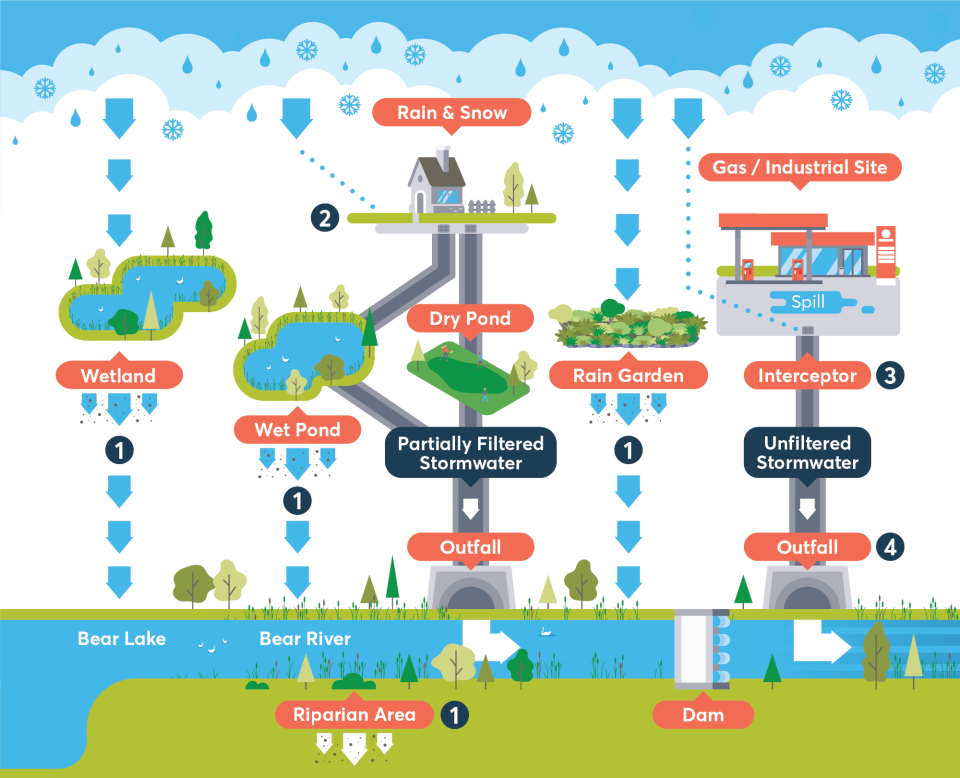
Stormwater gets collected and transported through Grande Prairie's inter-connected storm system. It consists of:
- Open waterways, channels
- This can include: ditches, grass swales, rain gardens, stormwater ponds, dry ponds and wetlands
2. Streets, gutters, concrete swales, catch basins, manholes, and underground sewers
3. Interceptors
4. Outfall structures
Runoff enters into the storm system before finally flowing untreated into Bear River. This runoff will eventually make its way north to the Arctic Ocean.
An interceptor, also known as an oil/grit separator, is a device commonly used at gas stations, bulk chemical, and fuel storage facilities to prevent pollution from entering the municipal storm system. These interceptors are crucial for separating oil and other pollutants from water, thereby protecting the environment and public health.
Interceptors function by capturing and isolating pollutants, preventing them from flowing into public stormwater systems. Regular maintenance is essential as pollutants can accumulate over time, reducing the interceptor's effectiveness and potentially allowing contaminants to reach natural environments.
According to the Drainage Bylaw, property owners with interceptors or similar devices must maintain them and keep maintenance records available for City inspection. This ensures that interceptors continue to operate effectively, safeguarding our water systems and natural habitats.
Historically, we tried to get rid of stormwater as quickly as possible. However, water is a resource that needs to be managed in a sustainable manner. Stormwater is managed for two main reasons:
- Volume - to prevent flooding
- Quality - to reduce pollutants and enhance the environment
Alberta Environment and Water has many programs and services that address our water:
- Legislation
- Water Act
- Environmental Protection & Enhancement Act
- Fisheries Act
- Protection
- Standards and guidelines (Best Management Practices)
- Performance assurance
- Knowledge and awareness
- Legislation
- Bylaws
- Lot Grading Bylaw C-1366
- Ensures each lot has positive drainage
- Water is not directed towards an adjacent parcel
- Drainage Bylaw C-1241
- Prohibits materials from being released into the storm system
- Prevents interference with the storm system
- Animal Control Bylaw C-1226
- Requires owners to dispose of animal waste in a sanitary manner
- Lot Grading Bylaw C-1366
- Planning
- City of Grande Prairie - Storm Drainage Master Plan, 2018
- Provides standards, guidelines and design criteria for new development
- Identifies requirements for new development
- Identifies required upgrades to the existing system
- Maintenance
- Street sweeping
- Catch basin cleaning
- Clearing debris from inlets
- Bylaws
The best way to handle stormwater is to:
- Store it
- Spread it
- Sink it
Depending on your land-use, there are a variety of Best Management Practices (BMPs) that designers, engineers and landscapers can utilize to manage stormwater on your property. The BMPs are categorized as follows:
- Source control
- Lot level
- Conveyance
- End-of-pipe
- Low impact development
Stormwater Best Management Practices
Best Management Practices (BMPs) are used by engineers, designers and the municipality as due diligence. These are the 'industry standards' and are used to ensure compliance with legislation.
- Street sweeping
- Catch basin cleaning
- Bylaw enforcement
- Drainage bylaw
- Animal control bylaw
- Lot grading bylaw
- Reduced lot grading
- Surface ponding & rooftop storage
- Infiltration systems
- Sump pumping of foundation drains
- Vegetative swale / bioswales
- Vegetative channels / ditches
- End-of-pipe
- Wet ponds
- Dry ponds
- Wetlands
- Infiltration trench
- Infiltration basins
- Filter strips
- Sand filters
- Oil/grit separators
- Rain gardens
- Permeable pavement
- Green roofs
- Bio-swales
- Rainwater harvesting
- Rainwater stored in a cistern and disinfected and filtered before being used
- Uses: toilet flushing, outdoor hose bib, irrigation, cooling make-up, washing cars, washing clothes, washing buildings, fire protection, decorative fountains/ponds, dust suppression
- Trees
- Grass selection
Stormwater Monitoring Sensor Network
The City of Grande Prairie has a stormwater monitoring sensor network, consisting of 14 sensors, that monitors rainfall data, water levels, and water flow throughout the city. These 14 sensors include:
- Five rain gauges located throughout the city
- Four river level monitoring sensors located along Bear River
- Five storm sewer flow monitoring sensors located throughout the city
The rain gauges are active from May to November each year and collect data remotely. The information collected is analyzed once a year and is utilized as part of the City's Storm Drainage Master Plan.
The Bear River water level sensors are active year round and measure the water level during open-water season and the ice level, not thickness, during the winter. The information collected is used to inform the operation of the Bear River Dam and to provide advance warning of incoming high water levels.
Information collected by the Bear River water level sensors is available to view on the Alberta Environment and Parks website at https://rivers.alberta.ca.
The storm sewer flow sensors are active from April to November each year and measure the water flow within the city storm sewer network. Storm sewer flow information is collected in-person and is analyzed once a year. The information is also utilized as part of the City's Storm Drainage Master Plan.
The storm sewer monitoring sensors are relocated every few years to collect data from multiple areas in the city.
Stormwater Ponds
Stormwater ponds are areas that temporarily collect stormwater runoff and release it at a controlled rate. The ponds improve the quality of the runoff by allowing the suspended solids to settle. There are three basic pond types:
- Also known as a retention pond, these are typically dry
- There is a dry pond on the east side of the Community Knowledge Campus beside the running track. This type of pond allows the area to be utilized as a sports field during dry periods.
- Primarily used for quantity control
- Not normally effective in removing sediments or other contaminants
- Also known as a detention pond, always has water in it
- This allows the area to be enhanced aesthetically. There is a wet pond in Pinnacle Ridge that includes a fountain, paved walkways, benches, vegetation, etc..
- Its primary function is to remove sediments and trap floating scum and debris
- By utilizing existing wetlands into our storm system, we reduce our impact to the natural environment.
- There are wetlands in Crystal Lake
- Wetlands provide the most improvement to stormwater quality
- Their primary function is to remove pollutants by aquatic vegetation and microbiological processes
- They recharge the base flow of the groundwater
Stormwater FAQ
Catch basins are the main access point for storm water to get into the underground pipe system. The metal grates that are visible at the edge of the road are only a part of the catch basin structure. Under the sidewalk there is a barrel that collects water as well. The barrel is attached to a pipe that water flows away in.
The Storm Drainage Bylaw C-1241 (9) requires downspouts to end at least two metres away from any city sidewalk, reserve, road, park, alley, lane or surface drainage facility. The two metre buffer zone permits some of the run-off to absorb into the ground rather than enter the storm system. This also helps avert icing on sidewalks and lanes in winter.
Downspouts should never be connected to the weeping tile of your house or building. This increases the risk of basement flooding.
Grande Prairie's underground storm-drainage pipes are designed to deal with low-intensity rainfalls, which are the majority of what we receive. The underground pipes meet the North American Standard of draining one-in-five-year storms. The Grande Prairie area gets about 20 millimetres of rainfall in one hour in a one-in-five year storm event.
For detailed information on Alberta's legislation and guidelines visit alberta.ca.
Prohibited materials are any substance that may, directly or indirectly, obstruct the flow of water within the storm drainage system or that may have a negative impact on the receiving waters.
Prohibited materials include, but are not limited to:
- soil, sediment, waste or other solid material;
- Fecal matter, animal waste, dead animals or animal parts;
- Cooking oils and greases, soaps or detergents;
- Gasoline, motor oil, transmission fluid, and antifreeze;
- Solvents, paint;
- Cement or concrete wastes;
- Water from hot tubs;
- Sawdust, wood, fibreboard or construction material;
- Yard waste;
- Pesticides, herbicides or fertilizers;
- Hazardous, industrial, or biomedical waste
Components of the surface drainage system include paved walkways and grassed or concrete drainage courses (swales). Bylaw C-1241 (13) requires that the surface drainage be kept clear of debris and obstructions at all times. Retaining walls, terraces, gardens, or sheds cannot be constructed or placed in these areas. These systems are designed to carry rainwater and any obstructions could contribute to flooding during a heavy rainstorm. Concrete swales commonly run along the back or side of residential properties. If a fence is built over a concrete swale, there must be at least 0.15 meters (6 inches) of clearance between the bottom of the fence and the top of the swale.
Usually the water contains toxic disinfectants and chemicals that control algae. Even if water tests show that these chemicals are depleted, they remain in the water as a variety of toxic compounds. The City recommends that water from hot tubs and larger pools be drained or pumped to a household sink, toilet or floor drain connected to the sewer system.
The City recommends using a commercial car wash to clean your vehicle. Water from commercial car washes is discharged to the city's wastewater treatment facility where the wastewater is cleaned and treated before being returned to the river. If you choose to wash your vehicle in the driveway or street, do not use soap. Even biodegradable soaps will cause harm to living things in the river. Use only water and ensure that dirt or oil from your vehicle does not get washed down the storm drain.
Prior to an area being developed, rainwater easily soaks into soils, is absorbed by vegetation, and is evaporated into the air or travels over land to receiving wetlands, creeks and rivers. When an area is developed with buildings, driveways, roads and sidewalks, the rain cannot readily soak into the soil and journeys over and around these solid surfaces as runoff, reaching a waterway much faster. With no stormwater ponds, a large volume of water would enter a stream all at once, causing flooding and bank erosion. Runoff also collects assorted pollutants and debris as it flows over these surfaces, resulting in polluted water. Stormwater ponds are built to temporary hold this water then slowly release it back to the waterway, imitating the natural runoff rate and quality before development occurs. Wet ponds are critical in reducing the sediment that enters the river system, which can become a major threat to aquatic life.
The storm sewer system is a network of sewers, ponds, ditches and wetlands that transport storm water to the Bear Creek and eventually to the Wapiti River. Stormwater does not undergo the same treatment process as wastewater so it is important to prevent pollutants from entering the system and damaging the water ecosystem. The main purpose of the storm drainage system is to prevent flooding.
It is important that you report any/all spills or discharge of prohibited materials whether accidental or intentional.
If the release creates an immediate danger to public health and safety, call 9-1-1 for the fire department's Hazardous Materials Team to respond.
You should also report it to Alberta Environment's response line at 1-800-222-6514.
For other violations and incidents, please report them to the City of Grande Prairie's transportation maintenance department at 780-538-0354.
The Drainage Bylaw C-1241 is needed to regulate storm sewers and storm drainage within the City of Grande Prairie to preserve and protect the Bear River water quality and ecosystem.
Prior to disposing of water in storm drains, residents are encouraged to stop and think about what chemicals and other materials are in the water that could harm the river environment.
Only clean water should be put into storm drains. If the disposal water contains other substances it should be put into the sewer system through household drains or allowed to run-off on the ground to prevent the water from entering a storm drain directly.
The storm-drainage system is supported by the mill rate (property taxes). Major improvement projects to the storm sewer systems are currently financed through the Alberta Municipal Infrastructure Grant. Funding in future budgets for major storm drainage projects have been assigned to the Municipal Sustainability Initiative Grant.
Failure to comply with the drainage bylaw can result in fines ranging from $75 to $10,000 and/or the cost of containment and clean up. See schedule "A" of the Drainage Bylaw C-1241.